
Cost Optimization and Sustainability for Public Cloud Provider (Carbon Aware FinOps)
In collaboration with

This project aims to identify and implement metrics to understand the carbon footprint of the current CERN services hosted on Kubernetes. These metrics will inform the deployment of workloads in function of the Scope 3 emissions across on-premises and public clouds as a path to achieve low/zero-carbon workload deployment. Ultimately, these innovative results will have direct impact in the IT Department cloud operating model, where carbon awareness will be a costing factor being considered in the FinOps activity managing public cloud costs and optimizing cloud spending within CERN.
Overview
New trends in computing show a tendency to rely on AI, ML and other computing models that rely heavily on new generations of accelerator technologies. This has pushed costs and power requirements up significantly in many cases for maximum performance with alternative solutions focusing instead on cost and power efficiency.
As more computing workloads at CERN also start relying heavily on GPUs and other accelerators as well as ML, it is important to better understand the workload patterns to properly match the ideal infrastructure. With the speed of evolution in this new generation of architectures, it is also important to ensure the required flexibility to incorporate external resources seamlessly into CERN workloads.

Highlights in 2025
During 2025 the project was started with an initial focus on research, experimentation and preparation of the first two key deliverables.
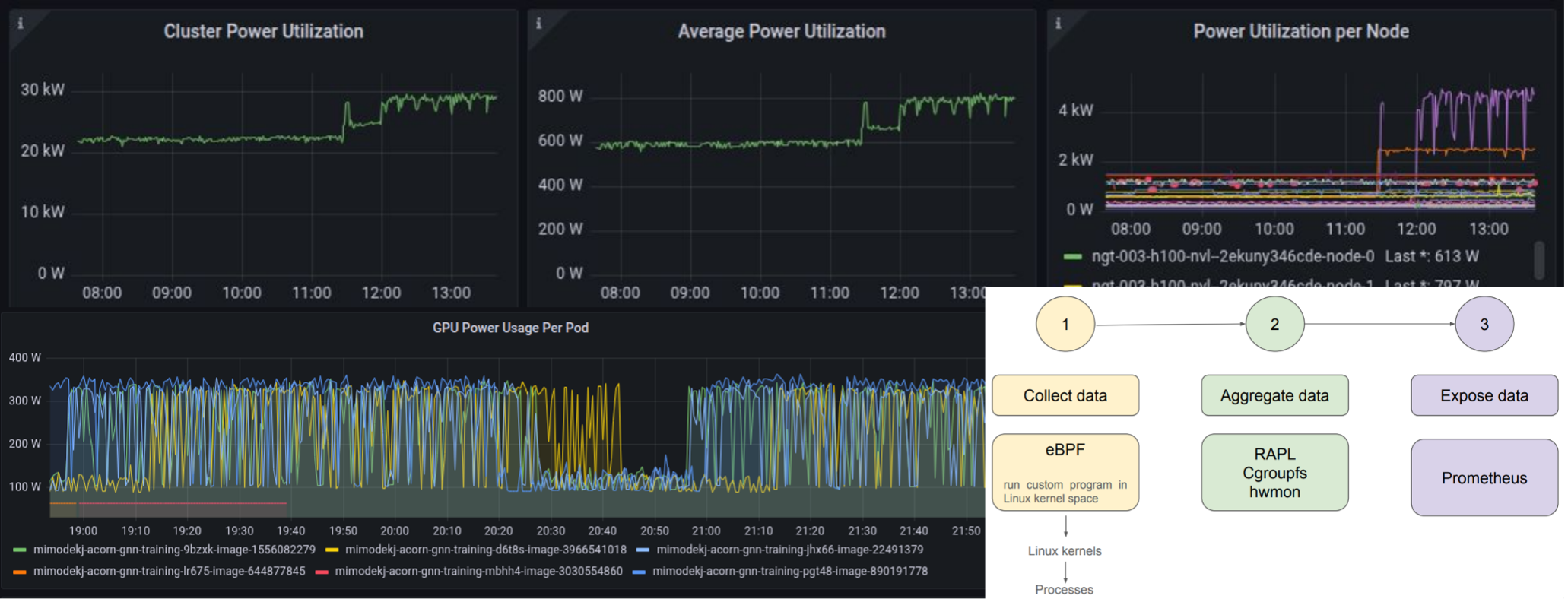
The first includes a report on the available tools for cost and carbon footprint metric collection, including an evaluation of projects such as Kepler and OpenCost within the CNCF ecosystem. The second report defines and compiles the relevant metrics for cost and carbon efficiency, to be validated against industry standards.
Practical tests were also performed by deploying Kepler and OpenCost on both Oracle and CERN cloud resources to begin collecting preliminary cost and energy usage data.
Next Steps
During 2026 the project will continue with the completion and validation of the report on cost and carbon efficiency metrics. The focus will then be on delivering a proof-of-concept deployment and implementation integrating the selected tools and generating metrics for reference use cases. The initial focus will be on reporting rather than automated scheduling, covering different types of workloads.

Publications & Presentations
Laura Llinares, Amine Lahouel, Overview of available power metrics. Presented to the Next Generation Triggers (NGT) Work Package 1.1 (05 September 2025): https://indico.cern.ch/event/1580626/
Technical Team
Laura Eve Sarah Llinares, Ricardo Rocha
Project Coordinator
Ricardo Rocha
Collaboration Liaisons
John Lathouwers, Dan Tow