
Expanding CERN’s Expertise in NVIDIA Technologies for Scientific Computing
In collaboration with

Advance scientific research and IT capabilities through cutting-edge computing technologies. This partnership, developed within CERN IT’s Heterogeneous Architecture Testbed, focuses on three key areas: digital twins, advanced computing architectures, and high-precision numerical libraries.
Overview
By leveraging NVIDIA’s expertise, CERN aims to enhance simulation workflows, optimize data processing, and improve computational accuracy, all of which are essential for high-energy physics research.
Highlights in 2025
The project has just started, and we are currently laying the foundation for its full development.
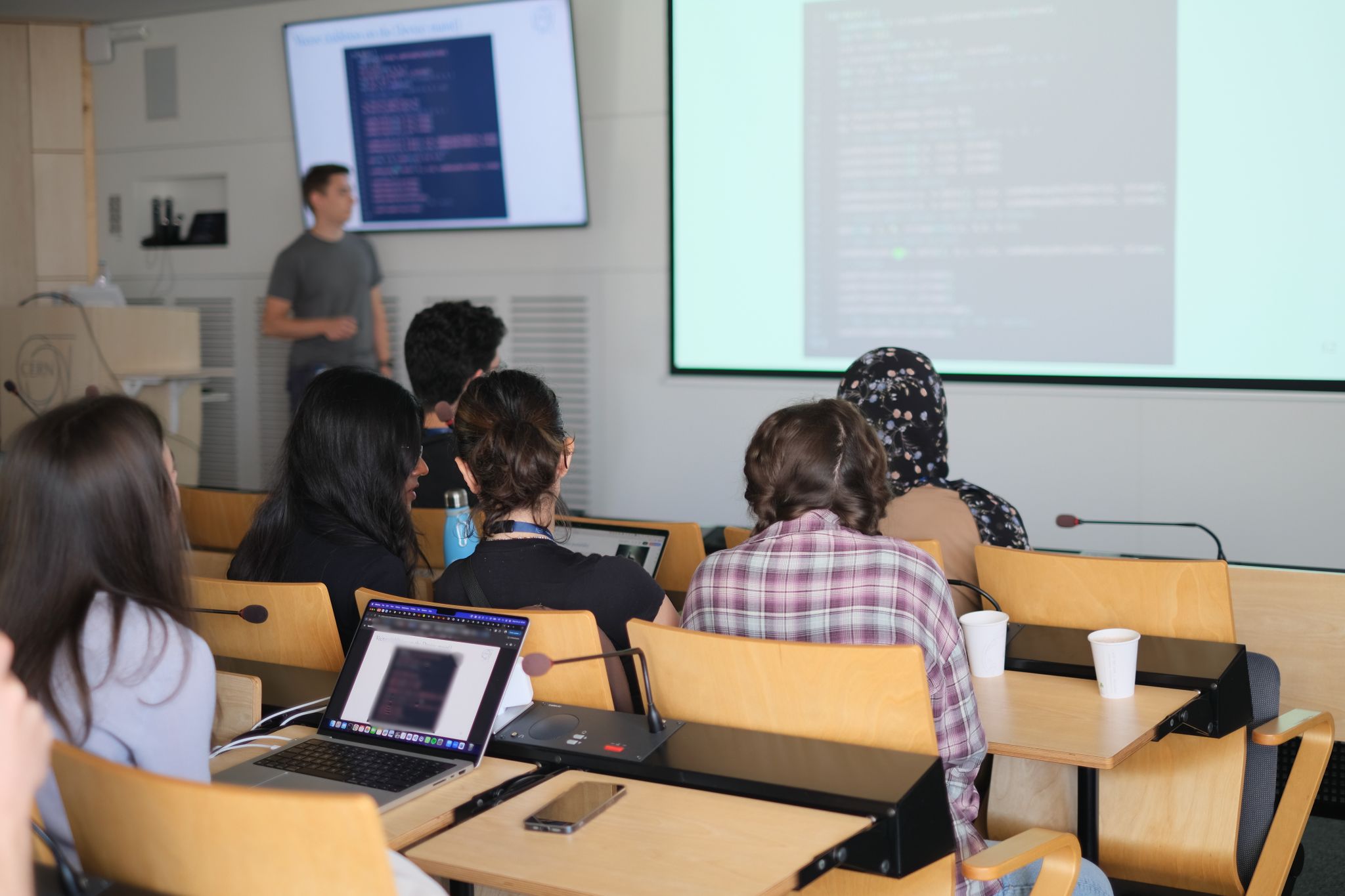
In 2025, CERN openlab co-organised two dedicated workshops in collaboration with NVIDIA, focusing on accelerator-based computing and AI technologies relevant to scientific research.
Next Steps
In 2026, directions include:
- Benchmarking GPUs/DPUs for Monte Carlo/track reconstruction efficiency.
- Mixed-precision FP64/FP16 optimization on AI hardware for 10x gains in event generation and pile-up mitigation.
- NVIDIA Holoscan enabled low-latency GPU streaming pipelines at CERN for real-time detector data processing.
- Omniverse digital twins with CAD models and live streams.
Presentations & Publications
A. Koehler, NVIDIA Compute Update and Recent Developments in HPC Software. Presented at the CERN openlab Technical Workshop, Geneva, 2023
Technical Team
Luca Atzori, Maria Girone, Matteo Bunino, Joaquim Santos, Albane Carcenac, Jessy Sobreiro, Stefan Roiser, Ioannis Xiotidis, Stefano Veneziano, Thorsten Wengler
Project Coordinator
Luca Atzori
Collaboration Liaisons
Martin Roosen, Tom Gibbs, Peter Messmer, Sebastian Kalcher, Adam Thompson