
BioDynaMo: Biology Dynamics Modeller
In collaboration with

BioDynaMo is a platform that empowers scientists to effortlessly generate, execute, and visualize agent-based simulations. Utilizing cutting-edge computing technologies, the BioDynaMo platform facilitates simulations of unprecedented scale and complexity. This capability opens avenues for addressing intricate scientific research inquiries with greater ease.
Overview
In the life sciences community, computer simulation is gaining prominence for modelling intricate biological systems. While numerous specialized tools exist, creating a high-performance, versatile platform represents a significant advancement. CERN leverages its extensive expertise in large-scale computing, supported by funding through the CERN and Society Foundation, to address three highly relevant societal needs: the fight against cancer, inequalities and dengue. Additionally, BioDynaMo is part of the CERN IT department’s efforts to build a Digital Twin Engine for Science, with its integration in projects such as interTwin, making it accessible to a wider range of researchers.
Highlights in 2025
In 2025, work focused on improving the usability and accessibility of the BioDynaMo platform. The installation process was streamlined to support a wider range of environments, and the documentation was expanded to assist new users and developers. These improvements enhance the platform’s readiness for broader adoption within the research community. Integration with the interTwin Digital Twin Engine also advanced, enabling initial test simulations within the framework.
Progress on the tumour growth use case continued. A pancreatic tumour model that incorporates selected biological processes related to tumour progression and immune response was developed, guided by recent computational studies. The aim is to first replicate established computational tumour models to ensure consistency and validation, then develop a reproducible and extensible model that can support future research and biomedical insights.
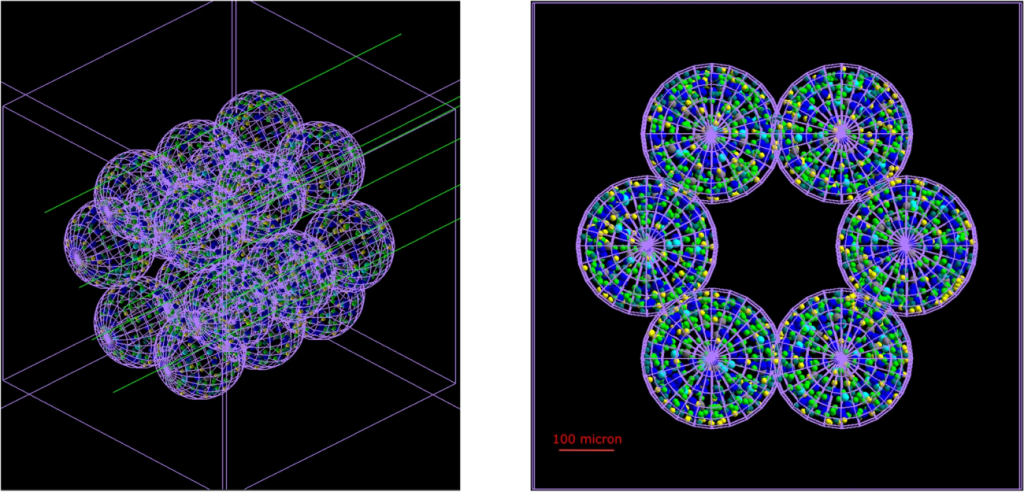
BioDynaMo was also used in research by Cayla Harris et al. to study retinal development using agent-based modelling, illustrating how biological mechanisms and stochastic cellular decisions can be explored through simulation.
These developments contribute to strengthening the platform’s reliability and usability while preparing it for a wider range of applications in digital biology and computational medicine.
Next Steps
The next phase will focus on completing and validating the pancreatic tumour model and documenting its implementation. Parallel work will continue to maintain and evolve the core software. A second biological use case will be initiated, simulating dengue and other infectious disease transmission dynamics, further broadening BioDynaMo’s scientific applications.

Publications & Presentations
C. Harris, U. Abubacar, R. Bournes, T. Adel, A. Tamaddoni-Nezhad, R. Bauer, Agent-based modelling of retinal development. Bioinformatics and Biomedical Engineering (IWBBIO 2025), https://doi.org/10.1007/978-3-032-08452-1_6
S. Portokalidis BioDynaMo: Biology Dynamics Modeller (5 March). Presented at CERN Openlab Technical Workshop, Geneva, 2025. URL: https://indico.cern.ch/event/1440389/
S. Portokalidis BioDynaMo: Biology Dynamics Modeller (26 November). Presented at End-of-year Get together – CERN & Society Foundation, Geneva, 2025. URL: https://indico.cern.ch/event/1615976/
Technical Team
Maria Girone, Eric Wulff, Stavros Portokalidis
Project Coordinator
Maria Girone
Collaboration Liaisons
Roman Bauer, Vasileios Vavourakis