
Industrial Edge-Cloud and AI-based Agents
In collaboration with

Profiling of Siemens’ virtual PLCs real-time capabilities. Design and implementation of a test bed for large scale distributed deployment exploration of vPLCs. Implementation of source code generation AI agents for PLC languages and integration with WinCC OA tooling. POC analysis and implementation of AI-enabled applications, integrating with Industrial Control Systems and Operation processes.
Overview
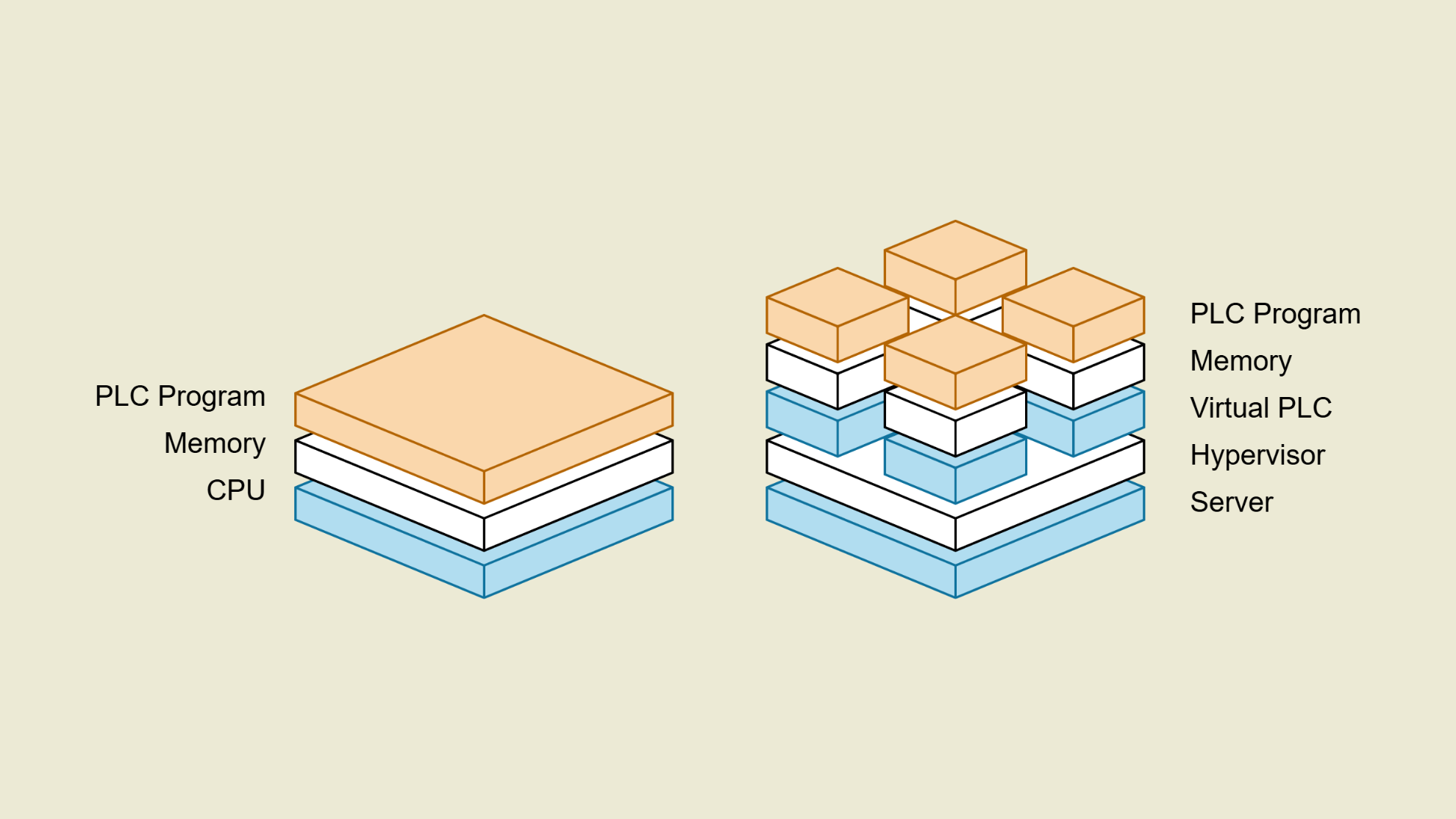
vPLC are a recent advancement that focuses on merging the fields of OT and IT by integrating the high reliability of PLCs with the convenience of IT infrastructures. Migrating PLCs applications to commercial off-the-shelf hardware allows to more easily provide maintenance to operation sites, removing complexities linked to the physical hardware devices, especially in distributed systems.
The thoughtful integration of AI agents in development and operational processes can substantially reduce the completion times of repetitive and non central tasks, leaving more time to the users to concentrate on their main activities.

Highlights in 2025
A dedicated edge-cloud testbed is being established at CERN to profile virtual PLCs across industrial edge devices, OpenShift, and local servers. This multi-tiered setup simulates real world conditions for comprehensive performance evaluation, focusing on behaviour, resource consumption, and bottlenecks. KPIs like cycle time, memory usage, I/O throughput, latency, and error rates are being tracked using profilers and monitoring agents.
A queryable knowledge base, built from WinCC OA and internal documentation, centralizes PLC programming and system architecture information. This resource facilitates efficient access to PLC function blocks, communication protocols, and troubleshooting guides. The knowledge base is being integrated with AI agents to explore automated PLC code generation using techniques like LLMs and code synthesis. This aims to accelerate development, reduce errors, and enhance code quality.
Furthermore, a use case analysis identified potential AI applications for DevOps and control room operations. Opportunities include predictive maintenance, anomaly detection, automated deployment pipelines, and real-time workflow optimization. This analysis prioritizes efficiency, reliability, and safety, guiding future AI development efforts and performance evaluation.

Next Steps
The immediate next steps involve executing comprehensive profiling experiments on virtual PLCs deployed across industrial edge devices, OpenShift, and local servers. A key focus will be the evaluation and benchmarking of Open Source Virtual Switch Solutions to explore their applicability for vPLC infrastructure. This assessment will determine whether OSS options can meet the performance, real-time, and reliability requirements, and if not, identify the specific gaps and improvements needed to enable their use in industrial deployment.
Project Coordinator
Fernando Varela Rodriguez
Technical Team
Filippo Berto, Fernando Varela Rodriguez, Abhit Patil
Collaboration Liaisons
Christian Kern, Silvio Becher, Stefan Langer